Real Estate Agent Retention: Signals and Stay Interviews
To keep agents on a real estate team, watch three things in Follow Up Boss: logged activity this month against last month, closings this quarter against last quarter, and paid tools nobody opens. Treat a dip as a question, not a verdict, and ask it in a short, regular stay interview before anyone has a reason to leave.

Pull up the last agent who left your team, open their Follow Up Boss timeline, and scroll back to the two months before they told you.
On a lot of teams, that scroll tells a story nobody read in real time. The calls thin out, the notes get shorter, a closing that should have happened in May slips. Then the resignation, which felt sudden, turns out to be the last thing that happened rather than the first.
This guide is for the team lead who would rather have that conversation in July. It covers the three signals worth watching, what each one cannot prove on its own, and the five questions to ask once you see one.
Leaving usually starts before the resignation
Turnover researchers have a name for the drift. Timothy Gardner and colleagues collected accounts from employees who quit voluntarily and from their managers, and built a measure of the behaviors people tend to show while they are on their way out. They call them pre-quitting behaviors. In their data, those observable behaviors predicted later voluntary turnover over and above the established predictors (Journal of Management, 2018). An earlier review by Peter Hom and colleagues described the same idea from the other side: a person’s withdrawal state, whether they want to stay or go, shows up in attitudes and behavior before it shows up as an exit (Psychological Bulletin, 2012).
Neither study looked at real estate agents, and neither says a quiet month means someone is leaving. What they support is narrower and still useful: the signs are often observable early, if somebody is looking.
The market adds a second reason to look. NAR counted 1,439,163 members on June 18, 2026, down from 1,463,352 a year earlier (NAR, June 2026). A smaller membership is a smaller pool of Realtors to recruit a replacement from.

Three signals already sitting in Follow Up Boss
You do not need a survey tool to see the drift. Follow Up Boss already records most of it, as long as your team logs its work there. If calls go through personal phones and never reach the timeline, fix that first; our guide to what actually syncs into Follow Up Boss walks through which activity lands and which doesn’t.
| Signal | How to read it | What it cannot prove |
|---|---|---|
| Activity trend | Each agent’s logged calls, texts, emails, notes, appointments and tasks over the last 30 days, compared with the 30 before. | A vacation, a heavy escrow month or a new baby all look like a dip. It also only counts what was logged. |
| Closings trend | Won deals in the last 90 days against the 90 before, by agent. | Closings are lumpy. Going from two to one is noise more often than news, and a co-listed deal may only credit one name. |
| A quiet seat | A paid login, a dialer or an add-on the agent has stopped opening. | It may be a broken password or a tool that never fit how they work. That is a fix, not a flight risk. |
One signal on its own earns a check-in. Two at once, especially a sharp activity drop alongside a quiet seat, earns a conversation this week.
There is a fourth moment that is not a warning sign at all: the agent who is close to their cap, or just hit it. The economics of their year change on that day. A team lead who says so out loud, before a recruiter does, has a much easier conversation. Our commission cap tracking guide covers how to see who is near theirs.
Before you trust the numbers
Two habits keep this honest. First, a missing number is not a zero. An agent who joined last month has no prior month to compare against, and that is “not enough data yet,” not “activity down 100%.” Second, check that your reports agree with each other before you act on one; if they don’t, the post on Follow Up Boss team reports that disagree explains the usual reasons, and our CRM dashboard audit lists the signs a number is lying to you.
The stay interview: five questions, asked the same way every time
An exit interview tells you why someone left. A stay interview asks the people still here why they stay, while the answer can still change something. SHRM publishes a five-question version by Richard Finnegan (SHRM, November 2023):
- What do you look forward to each day when you commute to work?
- What are you learning here, and what do you want to learn?
- Why do you stay here?
- When is the last time you thought about leaving us, and what prompted it?
- What can I do to make your job better for you?
Finnegan’s advice is to listen about 80 percent of the time. Use the same wording at every check-in, so that the difference between this quarter’s answers and last quarter’s is what you are reading. To be clear about the evidence: the article is practice guidance from someone who runs these interviews for a living. It does not cite a study showing they cut turnover, and we won’t pretend it does.
For agents, “commute to work” can mean the drive to a first showing. Keep the rest word for word.
How to open, depending on what you saw
| What you noticed | Open with | Avoid |
|---|---|---|
| A recent closing | “Walk me through the Maple Street deal. What made it work?” | Leading with the dip you also noticed |
| Activity down | “What’s taking most of your time right now?” | “Your numbers are down.” |
| Closings down | “What changed in your pipeline this quarter?” | Asking why the number dropped. The number is the symptom. |
| A quiet seat | “Is the dialer still working for you, or should we cancel it?” | Assuming they have checked out |
| Near or past their cap | “You’re close to capping. What would get you there, and what can I do?” | Waiting for them to raise it |
A 15-minute weekly routine
- Monday, five minutes: compare each agent’s last 30 days of logged activity with the 30 before. Note anyone down sharply.
- Check closings and caps: anyone with fewer closings this quarter, and anyone close to or just past their cap.
- Pick at most three names. A list of thirty is a list you will stop reading.
- Book the check-ins and run the five questions. Write down their words, not your summary.
- Log the date. Anyone who has never had a stay interview is due for one, whatever their numbers say.
Pick a cadence you will actually keep. Quarterly is a reasonable default for most teams; the point is that everyone gets asked, not just the agents whose numbers moved.
Where Ace fits
If you run Follow Up Boss with Ace Trove, the routine above is the Retention tab in Back Office. It reads its own versions of those signals from your account: logged touches month over month, closings quarter over quarter, and whether a paid Ace seat has gone quiet. It sorts each agent into at risk, watch or stable, and lists the reasons beside every name. When a source is missing, it says so in words, for example that there is no prior month to compare yet, instead of showing a zero. Retention risk is a label with its reasons attached, not a score.
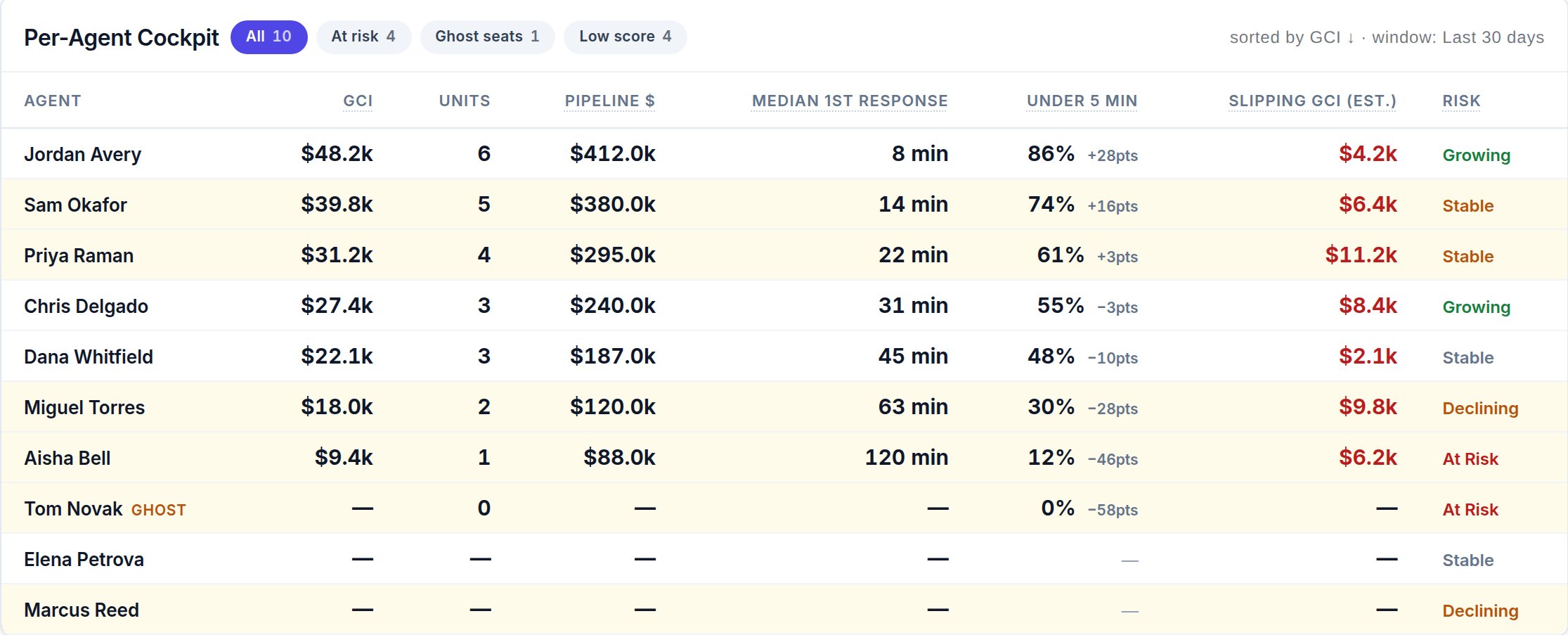
A Prepare button builds a short brief for one agent: at most four talking points, including a recent closing when there is one (with a note to open with it rather than the risk), and the cap position when a commission plan is on file, with the five SHRM questions attached below them. It is built from your account’s numbers, not written by a language model, and it hands you the numbers and the question rather than a script. You log each check-in, set your own cadence, and a weekly digest of at-risk seats goes to admin seats only, never to agent seats.
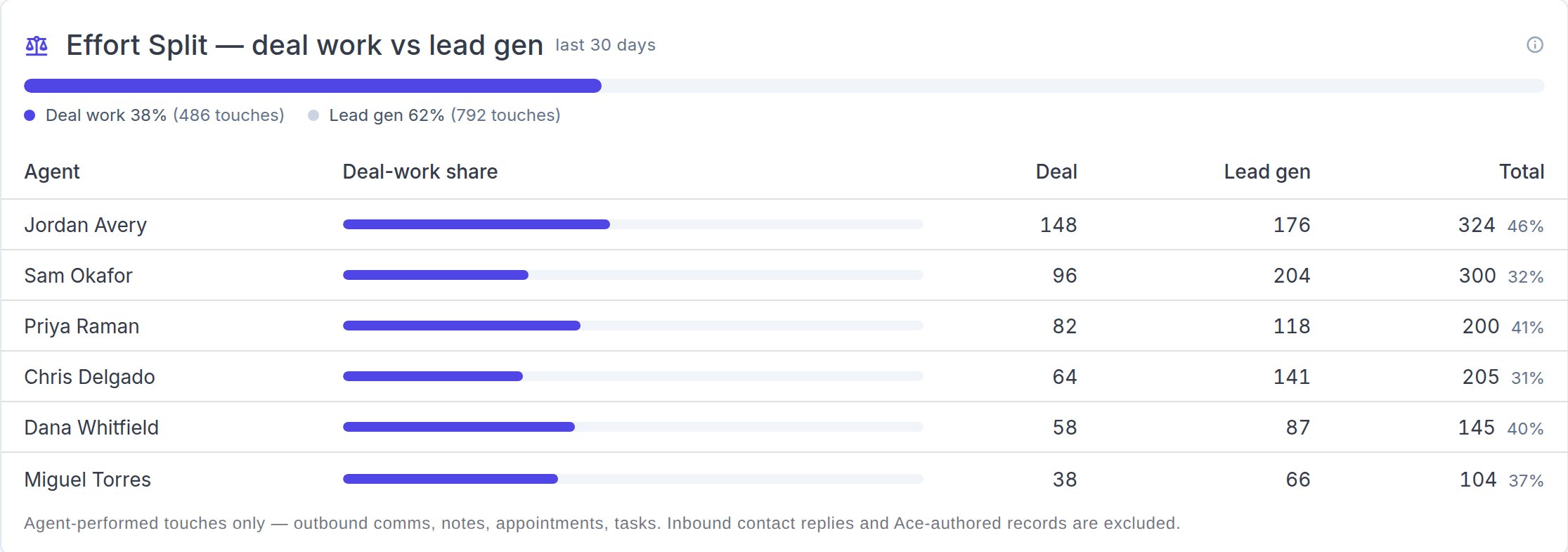
What it does not do: it cannot read the conversation an agent had at their kid’s soccer game with a recruiter. It sees what lands in Follow Up Boss, and the read is only as good as your team’s logging. Retention, commissions and Transactions need Trove. The Recruiting board next to them works on every account, including the first 25 contacts in your database that Ace has classified as other agents; Trove pages through more of them. Those are the same people our post on separating non-leads in Follow Up Boss tells you to keep out of your lead counts. Our plan guide covers what each tier includes, and the page for team leads shows the rest of what Trove does for a team.
Frequently asked questions
What is a stay interview in real estate?
A stay interview is a short, regular one-on-one where a team lead asks an agent why they stay and what would make the work better, before anything is wrong. It is the opposite of an exit interview, which only explains a decision that has already been made.
How often should a team lead run stay interviews?
Pick a cadence you will keep for every agent, not only the ones whose numbers moved. Quarterly is a sensible default for most teams, with an extra check-in after a big change such as a new split, a cap, or a lost deal.
Can Follow Up Boss data predict which agents will leave?
No report can predict a resignation. Logged activity, closings and unused tools can flag an agent worth a conversation, and research on pre-quitting behaviors suggests the signs often show early. A dip is a reason to ask, never proof.
A question for team leads who have run these for a while: which of the five questions gets the most honest answer from agents? We would guess number four, but would rather hear it from someone who has asked it across a table.
See what Ace Trove does for a team
Back Office, with its Retention and Commissions tabs, is one part of Trove, the layer that works across your whole Follow Up Boss account.
Explore Ace Trove