Commission Cap Tracking: The Deal That Breaks Spreadsheets
To track a commission cap, add up the brokerage’s share of each closed deal in close-date order, inside the agent’s own cap year. On the deal that crosses the cap, the brokerage keeps only the remaining headroom and the agent gets the rest. Shared deals need a split someone actually agreed to.

An agent who is $2,000 short of a $20,000 cap closes a deal that pays $12,000 in commission. On a 70/30 split, the brokerage’s normal share would be $3,600. The right number is $2,000.
The brokerage takes the $2,000 of headroom left under the cap, and the agent takes the other $10,000. A spreadsheet that applies the usual 30% to the whole check shorts the agent $1,600 on the one deal they have waited all year for. It is the easiest cell in cap tracking to get wrong, and the agent is the person most likely to notice.
Below: the crossing deal, five other places cap math goes wrong, and the fields a tracker needs. (Every dollar figure here is a worked example, not data from any team.)
The crossing deal, worked out
A commission cap is a ceiling on what the brokerage collects from one agent in a cap year, often called company dollar. Below the cap, each deal splits normally. Once the brokerage’s share for the year reaches the cap, the agent keeps the post-cap share, typically close to 100% minus small per-deal fees.
Here is the example deal with the arithmetic shown:
| Step | Calculation | Result |
|---|---|---|
| Commission on the deal | — | $12,000 |
| Brokerage share at the normal split | $12,000 × 30% | $3,600 |
| Headroom left under the cap | $20,000 − $18,000 already paid | $2,000 |
| Brokerage keeps | the smaller of $3,600 and $2,000 | $2,000 |
| Agent keeps (before fees) | $12,000 − $2,000 | $10,000 |
If the post-cap split is below 100%, the part above the cap is split at that rate instead. Either way, the crossing deal is calculated in two parts.

Five more places cap math goes wrong
1. The cap year is not the calendar year
Cap plans reset on one of two dates: the agent’s anniversary with the brokerage, or January 1, so an anniversary cap year might run July to June. A tracker built on January-to-December rows will reset the agent’s cap six months early or six months late. Store the month each agent’s cap year starts, and group deals by cap year, not by the year in the close date.
One consequence catches people out: a calendar-year report for an agent with a July cap year still needs the previous January-to-June deals. They are not this year’s totals, but they decide where the agent stood when the year began.

2. Deals have to be counted in close-date order
Which deal crosses the cap depends on order. Enter deals as paperwork arrives instead of by close date, and the sheet can pick the wrong crossing deal. Sort by close date before any cap math runs. A deal with no close date cannot be placed in a cap year at all, so flag it rather than guess.
3. Fees and royalties may not count toward the cap
A transaction fee or a franchise royalty reduces what the agent nets. Whether it also counts toward the cap is a term of the plan, and brokerages differ, so get it in writing. If your plan counts only the split and the sheet adds fees into the cap column anyway, the agent appears to cap early and the brokerage under-collects for the rest of the year.
4. Shared deals need a real split
When two agents work one deal, the honest split is whatever the team actually agreed. Splitting 50/50 because it is tidy can invent dollars for one agent and remove them from the other, moving both cap positions. Until the agreed split is entered, credit the deal one way and mark it shared.
5. An estimate looks exactly like a real number
When a closed deal has no commission recorded, it is tempting to fill in price × 2.5% and move on. That guess then feeds the cap position and maybe a disbursement. Keep estimated rows visibly marked until the real figure is in, and never pay out from one.
A sixth shows up on graduated splits: when a deal pushes an agent into the next tier, decide in writing whether it pays at the starting or the ending tier, and apply that every time.
What Follow Up Boss records, and what it leaves to you
Follow Up Boss added commission tracking to deals in 2022: each deal has a commission field, plus separate fields for the agent split and the team split. Owners and admins see those values in the deals report, which our guide to performance reporting in Follow Up Boss covers.
None of those fields knows about a cap. The cap lives in each agent’s plan, not on the deal, so the running position has to be computed somewhere else. Two more gaps matter: a deal can list several agents, but the agent split is one field per deal, not one per agent; and a deal where nobody filled in the commission is just blank.
So the first habit worth building has nothing to do with cap math: enter the commission on the deal when it closes. Every downstream number gets more honest once that field is filled. Referral fees need the same discipline; see tracking referrals in Follow Up Boss.
The cap tracker checklist
Whether you run this in a spreadsheet, a transaction management tool or something else, these are the fields that make the math come out right:
| Field | Why it matters |
|---|---|
| Agent split % | The normal brokerage share below the cap |
| Cap amount (or “no cap”) | No cap is not the same as a $0 cap. Show it as not applicable, not 0% |
| Cap-year start month | Anniversary caps reset on the agent’s date, not January 1 |
| Post-cap split % | Close to 100% is typical, but check the plan |
| Per-deal fee, and the post-cap fee if different | Reduces net; whether it counts toward the cap is a plan term |
| Royalty % and royalty cap | Agent-side deduction with its own ceiling |
| Close date on every deal | Determines the cap year and the crossing deal |
| Observed or estimated commission | So estimates never pass as real dollars |
| Agreed split on shared deals | Entered by a person, never assumed |
| Plan effective date | A mid-year plan change should not rewrite deals closed under the old terms |
Tell agents where they stand, especially halfway
There is a reason to share cap progress rather than keep it in the back office. In a field study, members of a café reward program bought coffee more frequently the closer they were to earning a free coffee (Kivetz, Urminsky and Zheng, 2006). A later study found motivation can be higher when people are far from or close to a goal, and lower around the halfway point (Bonezzi, Brendl and De Angelis, 2011).
Neither study looked at real estate agents or commission caps, so treat this as a reason to try, not proof. It does point somewhere practical: the agent at 50% of their cap may be the one most worth a pipeline conversation, and that conversation goes better when they can already see the number.
How Back Office runs this inside Follow Up Boss
Back Office is part of Ace Trove, our account-wide layer for Follow Up Boss teams. A team admin sets up each agent’s plan once: split, cap, cap-year start month and transaction fee. Graduated tiers, post-cap terms, royalties and goals are optional. The ledger is then computed from the closed deals already in your Follow Up Boss. Nobody types in each deal.
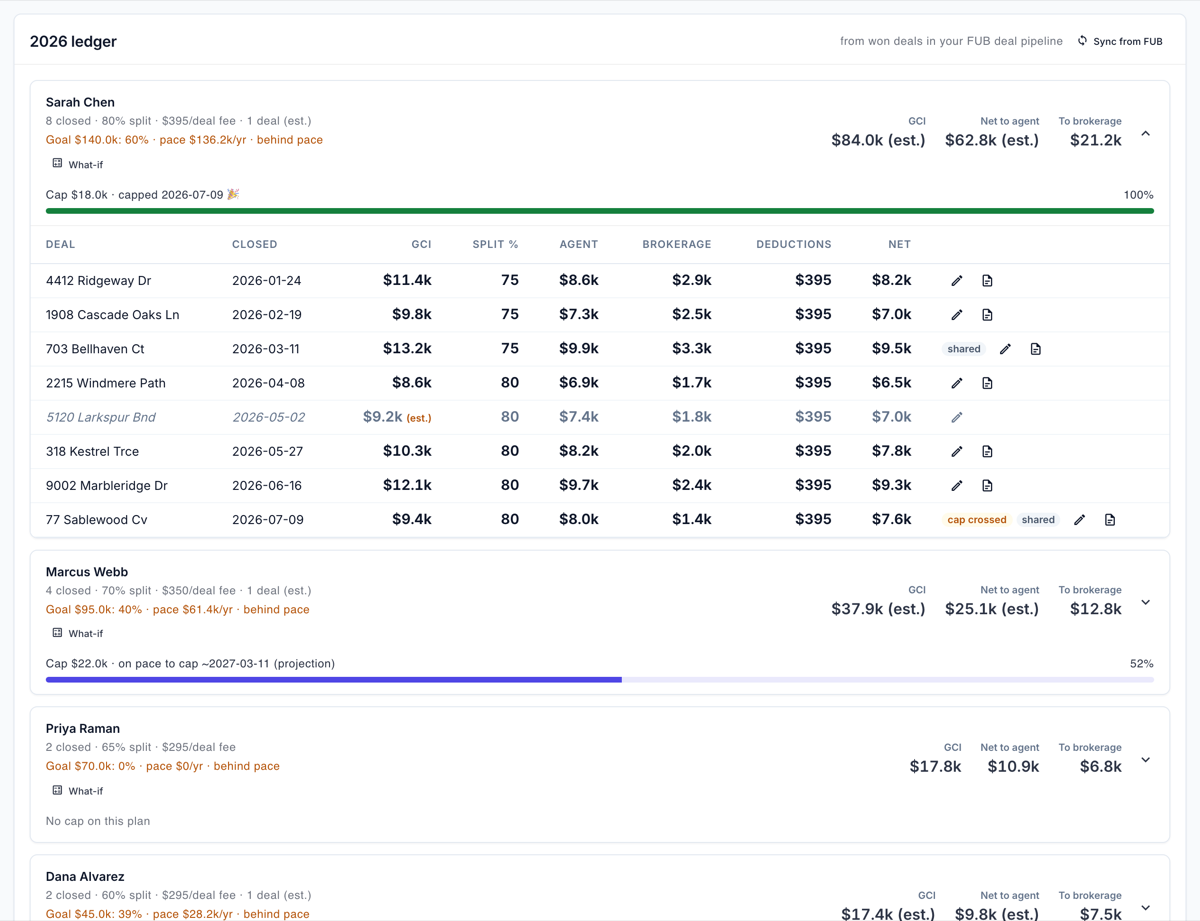
Against the checklist above:
- The crossing deal is split exactly. The brokerage keeps only the headroom on that deal, and the row is tagged “cap crossed.”
- Each agent’s cap year starts in their own month, deals accrue in close-date order, and a deal with no close date is counted and set aside, not guessed.
- Shared deals are flagged, not split by guesswork. By default a multi-agent deal is credited in full to the first agent listed and tagged shared. An admin can enter the agreed split for that deal, and both agents’ ledgers then divide it exactly as entered.
- Estimated dollars are labeled (est.). When Follow Up Boss has no commission on a closed deal, the ledger uses an estimate and marks it. The disbursement authorization (CDA) refuses to generate from an estimated deal until someone enters the real commission.
- Plan changes can be dated, so deals that closed under the old terms keep their old math.
- Agents see their own standing. The “My Commissions” card in the Ace Companion shows each agent their own cap-year summary, never anyone else’s. They also get a notification as they pass 75%, 90% and the cap, counted only from commissions recorded in Follow Up Boss or entered by an admin, so an estimate never triggers one.
- “What if” replays the real year: admins can test proposed terms against an agent’s actual closed deals before changing the plan.
What it does not do
- It is not accounting software. It computes from what Follow Up Boss records. Verify disbursements against the settlement statement.
- It does not guess a split on a shared deal. Until an admin enters one, the deal sits on the first-listed agent’s ledger, tagged shared.
- Only the brokerage’s split counts toward the cap. Fees and royalties reduce the agent’s net but never accrue toward it, so a plan that counts transaction fees toward its cap will not match.
- It does not prorate a deal across two tiers. You choose starting-tier or ending-tier treatment, and the crossing deal is paid at one rate.
- The projected cap date is a straight-line pace, labeled as a projection. A slow spring will move it.
- The milestone notifications skip the halfway point that the research above singles out. That conversation is still yours.
- It needs Ace Trove. Commission plans and the agent card are Trove features. Base Ace seats do not include them.
The Back Office help article walks through setup step by step. If you are weighing what the hours saved are worth, our ROI methodology post shows how to put a number on it honestly.
Frequently asked questions
What is a commission cap in real estate?
A ceiling on the commission dollars the brokerage collects from one agent in a cap year. Below it, each deal is split at the agent’s normal rate. Once the brokerage’s share reaches the cap, the agent keeps the post-cap share, typically close to 100% minus small per-deal fees.
Do transaction fees count toward a commission cap?
It depends on the plan. A transaction fee or royalty always reduces what the agent nets; whether it also counts toward the cap is a term each brokerage sets, so check the plan documents. Back Office counts only the brokerage’s split toward the cap.
Does Follow Up Boss track commission caps?
Follow Up Boss records a commission field plus agent-split and team-split fields on each deal. The cap itself lives in each agent’s plan, so the running position against it has to be computed outside the deal: in a spreadsheet, a back-office tool, or Back Office in Ace Trove.
See what Ace Trove does for a team
Back Office is one part of Trove, the layer that works across your whole Follow Up Boss account.
Explore Ace Trove