Follow Up Boss Appointment Outcomes: The Same-Day Debrief
Debrief every Follow Up Boss appointment the same day, in two parts. Pick an outcome from your account’s list so reports and filters can count it. Then write a short note in the client’s own words: what changed, what happens next, and when. The client’s exact phrasing is the first thing memory drops.
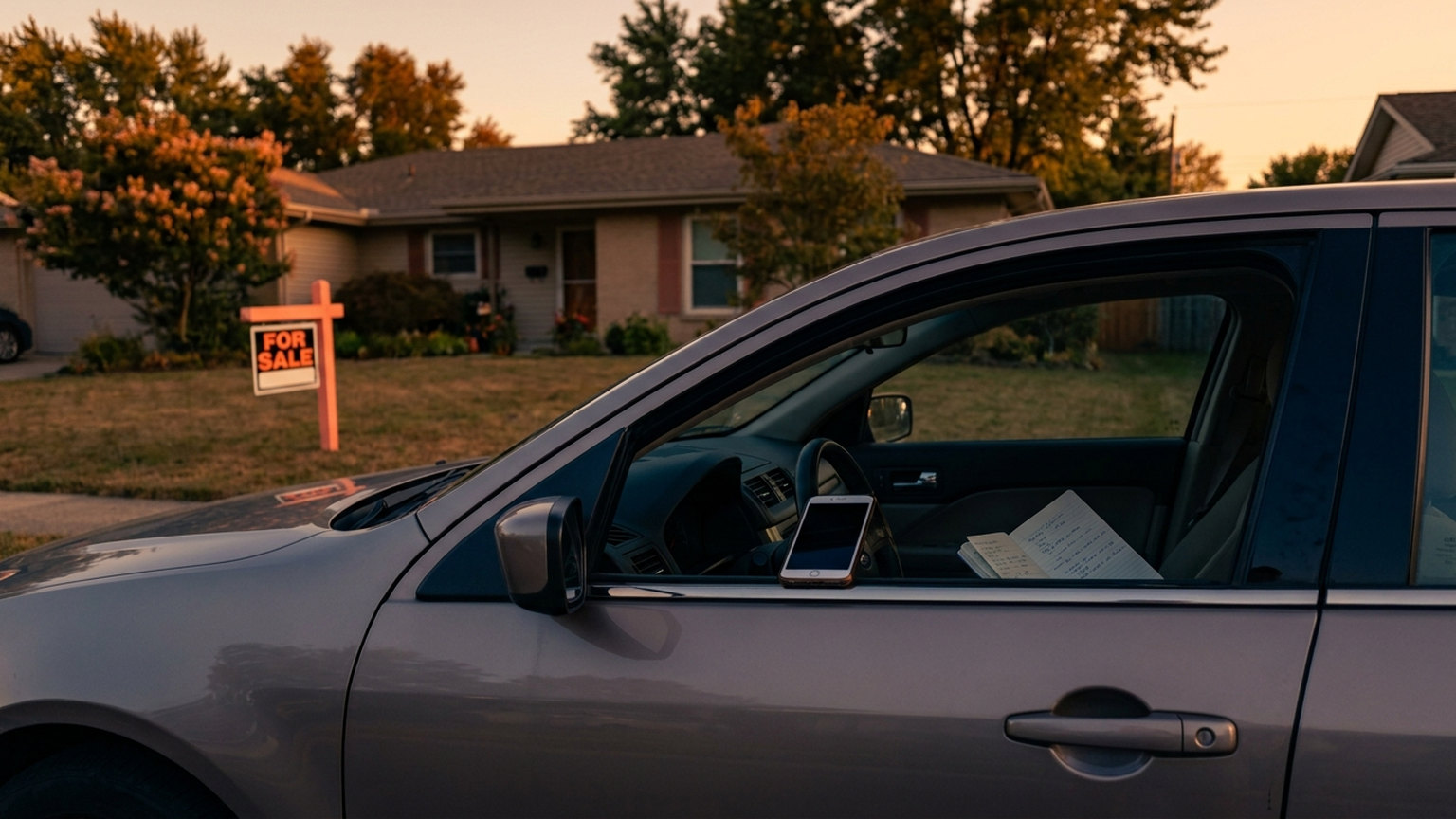
Write it in the car at 4:15 and the note says: “Loved the kitchen. Hated that the yard backs onto the road. Wants to see the one on Elm before Sunday.” Write it the next morning and it says: “Showing went well.”
Both notes are honest. Only one of them tells the next person who opens the contact what to do. And in Follow Up Boss, both versions usually sit next to an appointment whose outcome field is still blank, which means no report can count it either.
This post covers the two halves of a good debrief: the outcome (the part your reports read) and the note (the part people read). There is a 60-second script, a starter outcome list, and the habit check a team lead can run in five minutes a week.
Why the same afternoon matters
Memory does not fade evenly. In a 2018 lab study, Jerry Fisher and Gabriel Radvansky tested how well people remembered word lists and short stories at delays of up to 12 weeks. The exact wording was forgotten to around chance after about an hour. The specific details held for roughly a week and then dropped sharply. Memory for the overall gist of what happened stayed high throughout, with only some loss.
Those were people reading stories in a lab, not agents walking buyers through houses, so treat the timings as a direction rather than a rule for your Saturday. But the order maps neatly onto a showing:
- Gone first: what the client actually said. “Fine, I guess” about the second bedroom is a signal. By tonight it is a vague impression.
- Gone within days: the specifics. Which house had the slope problem? Was the budget ceiling $450k or “around $450k”?
- Kept longest: “It went well.” Which is the least useful sentence in the whole CRM.

The two halves of a debrief in Follow Up Boss
A Follow Up Boss appointment has an outcome field. It is a pick from a list your account defines, not free text. Follow Up Boss stores each outcome as a name with a sort order, and every appointment points at one of them, or at nothing.
The outcome and the note do different jobs, and a debrief needs both:
| Outcome | Note | |
|---|---|---|
| Format | One choice from your list | A few sentences, free text |
| Who reads it | Reports, filters, and anyone counting appointments | The next person to open the contact, including you in three weeks |
| What it answers | What kind of result was this? | What did they say, and what happens next? |
| What breaks without it | Appointment counts can’t separate a signed client from a no-show | The follow-up call starts from scratch |
If this sounds familiar, it is the same problem as deal stages. A stage nobody keeps current makes every pipeline report wrong, which is why we wrote a whole post on auditing deal stage names. Appointment outcomes are the smaller version of that box.

Set up an outcome list your agents will actually use
Outcome lists tend to fail in one of two ways. Some have two options, so everything is “Met.” Others have fourteen, so agents skip the field. Aim for five to seven outcomes, each tied to a different next step. Here is a starter list to adapt. It is an example, not a Follow Up Boss default:
| Outcome | Use it when | Next step it implies |
|---|---|---|
| Signed buyer agreement | Buyer consult ended with a signature | Start the search, set showing cadence |
| Listing signed | Listing appointment won | Prep, photos, launch date |
| Interested, follow up | Real interest, no commitment yet | A dated task, not a vague reminder |
| Wants more showings | Saw homes, none were right | Adjust the search with what they said |
| Not a fit | Wrong timing, wrong area, or another agent | Move to long-term nurture or close out |
| No show | The client didn’t come | Same-day reschedule attempt |
Two tips for naming:
- Name outcomes the way agents talk. “Signed buyer agreement” is what an agent says out loud. A code like “BA-1” is what they skip. Plain names also help any tool that matches spoken words to your list, including ours (more below).
- Keep names distinct. “Interested” and “Interested, follow up” will get mixed up by people and by software. If two outcomes share most of their words, merge them or rename one.
The 60-second debrief script
Five questions, answered in the car or on the walk back to it. Write the answers as close to the client’s words as you can. That is the part you can’t rebuild tomorrow.
- What happened? This becomes the outcome. Pick it now, from the list.
- What did they say, in their words? One or two quotes. “The commute would kill me” is worth more than “concerned about location.”
- What changed? Budget, timing, must-haves, a spouse who now has opinions, another agent in the picture.
- What happens next, and when? A date, not “soon.” If there is a next step, make it a task.
- Who else needs to know? A lender, a co-agent, the ISA who set the appointment.
Questions change a little by appointment type:
| Appointment | The question people forget to answer |
|---|---|
| Buyer consult | What is their real deadline, and what is driving it? |
| Showing | What did they say about each house, ranked? |
| Listing appointment | What price did they push back on, and what was their reason? |
| Open house (if booked as an appointment) | Who signed in and is not working with an agent? See our open house follow-up guide. |
What to leave out of the note
Write down what the client said about the homes and their own criteria, not your read on who they are. Notes about which neighborhoods would “suit” someone because of their family, religion, or background can become a Fair Housing problem, and CRM notes get read by more people than you expect. Our compliance page explains how Ace screens the messages it drafts for Fair Housing language; the notes you type yourself are still your call.
Making it a team habit
One person debriefing well helps one pipeline. A team needs the habit to be visible. Debriefs are well studied outside real estate: a 2013 meta-analysis of 46 samples by Scott Tannenbaum and Christopher Cerasoli found that debriefs improved performance by about 25 percent on average over control groups. The samples came from individuals and teams in medical and non-medical settings, in training and on the job, not from real estate agents. Nobody has measured your Tuesday showings. The direction is still worth taking seriously.
A five-minute weekly check for a team lead:
- Count past appointments with no outcome. That number is your debrief gap. Watch the trend, not one week.
- Look for the same name over and over. A missing outcome is usually a habit problem, not a one-off. Coach it in the one-on-one, as you would any CRM adoption problem.
- Check that appointments are booked in Follow Up Boss. If an agent books showings only on an outside calendar, there is no Follow Up Boss appointment to give an outcome to. Our calendar integration guide covers how the sync works.
- Track appointments next to the rest of your numbers. Appointment counts belong in the same review as response time and conversion. The KPI checklist has the full set.
Where Ace fits
If your account has Ace Trove, the debrief comes to the agent instead of waiting to be remembered. Between one and three hours after a Follow Up Boss appointment ends, the assigned agent gets an in-app notification and a backup email. Either one leads the agent into their own Ace chat, where Ace asks first, using the appointment’s own title: something like “How was the buyer consult with Dana?”
The agent answers the way they would tell a teammate. From that answer, Ace:
- proposes an outcome from your account’s own list, never one it made up;
- drafts a short debrief note, labeled as logged from the agent’s debrief;
- offers a follow-up task if the agent mentions a next step.
Ace confirms all of it with the agent in one message before anything is written to Follow Up Boss. Appointments that are cancelled, marked as a no-show, or already have an outcome are skipped, so nobody gets asked about something they already handled. For the team lead, the Appointment Follow-Up view in the admin dashboard shows the gap directly:
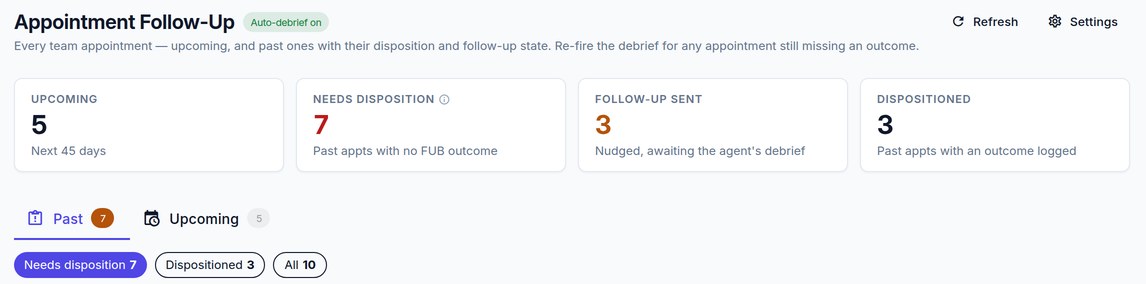
From that list, an admin can re-send the debrief prompt for any past appointment still missing an outcome. The Appointment Follow-Up help article walks through each tile.
What it does not do
- It never contacts the client. The prompt goes to your agent only, and never by text.
- It only sees Follow Up Boss appointments that have a contact and an assigned agent. An event that lives only on an outside calendar doesn’t get a debrief.
- It does not invent outcomes. Ace picks from your list and the agent confirms the pick. If nothing on the list fits, the outcome can stay blank and the agent’s words still go into the note. Plain, distinct outcome names make the right pick easier for people and for Ace.
- It cannot improve a vague answer. “Went well” in means “went well” in the note. The script above is still the agent’s job; Ace just asks at the right time.
- It is part of Trove, and an admin can turn the automatic prompt off for the account.
Frequently asked questions
What are appointment outcomes in Follow Up Boss?
An outcome is the result recorded on a Follow Up Boss appointment, picked from a list your account defines, such as “Listing signed” or “No show.” Because it is a fixed choice rather than free text, reports and filters can count it. The details belong in a note on the contact.
How soon after a showing should an agent write the debrief?
The same day, ideally within the hour. Memory research suggests exact wording fades first, within about an hour in lab studies, while specific details last days and the general gist lasts longest. The client’s own words are the part you cannot rebuild later.
Does Ace send showing feedback requests to clients?
No. Ace’s appointment debrief goes to the assigned agent only, as an in-app notification and a backup email. It never texts or emails the client. The agent tells Ace how it went, confirms what Ace proposes, and Ace logs the note, the outcome, and an optional task in Follow Up Boss.
See what Ace Trove does for a team
Appointment Follow-Up is one part of Trove, the layer that works across your whole Follow Up Boss account.
Explore Ace Trove