The contract-to-close checklist: which deadlines move, and which don't
Contract-to-close deadlines fall into two groups. Contingency items — earnest money, inspection, appraisal, title, HOA — count forward from the mutual acceptance date. Walkthrough, Closing Disclosure and possession count backward from closing. Anchor each item to the right date and moving one date moves only the items that should move.
Push a closing date back four days and thirteen deadlines move with it. Fifteen others don't move at all. They were fixed the day the contract went hard, and the new closing date has nothing to do with any of them.
That split is most of the job. The contract-to-close checklists you can download are usually one flat list of thirty-odd tasks in rough chronological order, which works right up until a date changes — and a date always changes. Once it does, a flat list can't tell you which rows to redraw, so somebody redraws all of them by hand, or nobody does.

The two anchors
Every deadline in a residential purchase hangs off one of two dates.
Mutual acceptance (the effective date, the date the last signature landed) starts the contingency clock. Earnest money, inspection, appraisal, title, HOA documents and the financing application all count forward from it. These are the buyer's investigation windows, and the contract sets them relative to the day the contract came alive.
Closing runs the delivery clock. Insurance binder, loan commitment, clear-to-close, the Closing Disclosure, the final walkthrough and possession all count backward from the settlement date. These exist to make a specific day work, so they move whenever that day moves.
When we built the seed checklists inside Ace we ran the survey rather than guessing: an item frequency table across eight published transaction-coordinator checklists, plus an offset survey across five standard contracts (TREC, the C.A.R. Residential Purchase Agreement, Colorado, FAR/BAR and Pennsylvania). Only items appearing in five or more independent sources made the cut. The forward/backward split held in every contract. It isn't a convention somebody invented; it is how the documents are written.
What counts forward from mutual acceptance
Buyer-side items, with the offsets our default template uses. Treat the day counts as prompts to start work, not as the deadline in your contract.
| Item | Offset | Why there |
|---|---|---|
| Executed contract reviewed — every page, all initials | +1 day | A missing initial is a phone call on day 1, a re-signing on day 20 |
| Intro / next-steps email sent to client and all parties | +1 day | You send it; the checklist only reminds you. The one message everyone remembers not getting |
| Title commitment + survey ordered | +1 day | "Within 24 hours" in every checklist surveyed |
| Escrow opened / contract delivered to title | +2 days | Nothing downstream starts until title has the contract |
| Earnest money delivered + receipt confirmed | +3 days | Uniform across the TX, CO, FL, CA forms |
| Inspection scheduled | +3 days | Scheduling is the constraint, not the inspection |
| Loan application submitted | +5 days | Deliberately ahead of the 21–45 day filing window |
| Seller disclosures received + reviewed with client | +7 days | Feeds the inspection and repair conversation |
| Inspection completed + report received | +10 days | Working end of the surveyed 7–17 day range |
| Appraisal ordered | +10 days | The lender's action, and it slips quietly |
| HOA / association documents received + reviewed | +12 days | The slowest third party in most transactions |
| Repair requests submitted + resolved | +15 days | Must close before the contingency date |
| Title commitment reviewed + exceptions objected to | +17 days | A review prompt, later than the 5–10 day objection window |
| Inspection / financing contingency — remove or object | +17 days | The date a buyer's agent is liable for missing |
| Appraisal received + value reviewed | +21 days | Top of the surveyed 14–21 day range |
Listing-side runs shorter on this half and the emphasis flips: disclosures delivered rather than received, inspection and appraisal access scheduled rather than ordered, and buyer contingency removal confirmed in writing rather than filed.
What counts back from closing
| Item | Offset | Why there |
|---|---|---|
| Homeowners insurance secured + binder to lender | −14 days | A missing binder stops funding, and it's someone else's job |
| Loan commitment received | −14 days | The last point where a financing problem is still fixable |
| Utilities transfer reminder sent to client | −5 days | Small, forgotten, and the client remembers |
| Clear to close received | −3 days | Gates the disclosure and the walkthrough |
| Closing Disclosure delivered + reviewed | −3 days | The federal three-business-day rule, approximated in calendar days |
| Wire instructions verified by phone with title | −3 days | The one omission that costs five figures |
| Closing time + place confirmed with all parties | −2 days | Cheap to do, expensive to skip |
| Final walkthrough completed | −1 day | Uniform 24–48 hours out across every form surveyed |
| Possession / key handover arranged | day of | Not automatically at funding in every state |
| Final signed documents delivered to client | +2 days | After closing, and still part of the file |
| Deed recording confirmed with the county | +3 days | Recorded is the thing that happened; closed is not |
| Review requested from client | +3 days | The only window where it's still vivid |
| Post-close follow-up | +30 days | Where the referral actually comes from |
Listing-side adds agreed repairs completed with receipts (−7), the commission disbursement authorization prepared (−5), the settlement statement reviewed with the seller (−3), and the MLS status updated to sold (+1).
Two items that are on the list for risk, not frequency
Most items earn a spot by showing up in five or more independent checklists. Two earned theirs a different way.
Wire instructions verified by phone. The FBI's Internet Crime Complaint Center logged 12,368 real estate fraud complaints in 2025 and more than $275 million in losses, up from 9,359 complaints and $173 million the year before, with the money moving during closings (NAR's summary of the 2025 IC3 report). The countermeasure is a phone call to a number the client looked up themselves, not a number in the email. It takes ninety seconds and it is the single highest-value line on the checklist.
The contingency removal deadline. It is not the inspection date, and treating them as one item is how the date gets missed. The inspection is when the work happens. The contingency deadline is when the buyer's right to walk expires. Our default template dates the inspection at acceptance+10 and the contingency at acceptance+17, seven days apart, on purpose.
Where flat date math stops being safe

Here is the part most checklist templates leave out, including ours.
Several state contracts count certain windows in business days, and extend a deadline that lands on a weekend or holiday to the next business day. The federal Closing Disclosure rule is business days too: the consumer must receive it at least three business days before consummation, and certain changes restart that clock (CFPB TRID FAQs). Day counting also varies in ways no generic template can absorb — Texas has its own rollover behavior, Washington applies a business-day rule to windows of five days or fewer with a 9 p.m. expiry.
Our date math is plain calendar-day arithmetic. It does not model business days, and it does not roll a date off a holiday. That is a real limitation and it is why the offsets above are set deliberately early: they are prompts to start work, not computed legal deadlines. The deadlines that bind live in the executed contract, and nothing here is legal advice.
If your team works more than one state, keep a per-state note beside the checklist instead of trying to encode the rules into the dates. Ace ships state-by-state guidance alongside a transaction for that reason, written as guidance: it never computes a deadline for you.
Does a checklist actually change anything?
Worth being honest about, since we sell one.
A 2022 systematic review in BMJ Open looked at 30 studies covering 25 distinct clinical checklists. Of the 14 that measured effect on outcomes, seven showed improvement, six showed none, and one was mixed (Al-Khafaji et al., BMJ Open 2022). So a checklist is not automatically worth anything.
The useful finding is which ones worked. Checklists built around concrete tasks reduced errors in five of seven studies; checklists built around prompting better thinking managed four of ten. Different domain, same lesson: "Order the title commitment" is a checklist item. "Review title carefully" is a wish. Every item above names an action and a responsible role because that is the version the evidence supports.
Running it where the deal already lives
A separate transaction platform drifts from your CRM because it is a second copy of the deal. You re-key the address, the price and the dates, and from that morning on the two disagree. Same gap whether you look at how Follow Up Boss connects to Dotloop, SkySlope and Brokermint or at what the free transaction tool stacks cover: two systems, one deal, no shared date.
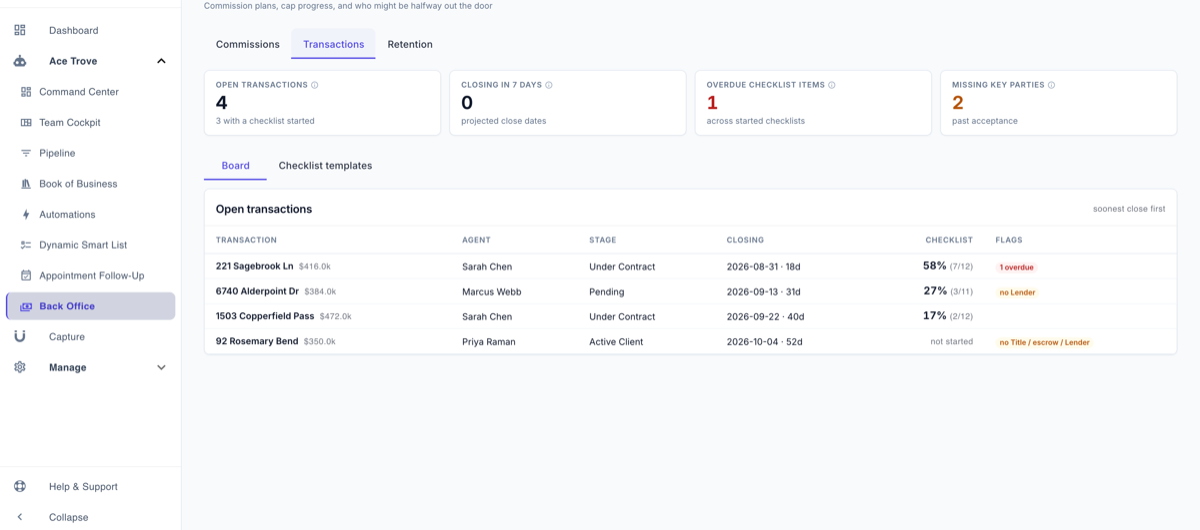
Ace hangs the checklist off the Follow Up Boss deal you already have, so there is one address and one set of dates. A few consequences of the two-anchor model that matter in daily use:
- Items store a rule, not a date. Move the projected close date in Follow Up Boss and every closing-anchored item re-dates itself the next time anyone opens the transaction. Nothing to migrate, no stale dates left behind.
- A missing anchor produces no date, and says which one is missing. With no acceptance date on the deal, the contingency items come back blank and labeled "needs an acceptance date." They are never guessed from today, from the created date, or from a neighboring item.
- Progress denominators are honest. Waived items leave the denominator entirely, and a checklist nobody has started reports "not started" instead of 0%.
- Edits flow back into the CRM. Dates and stage changes write to the Follow Up Boss deal on an explicit press, and only after Follow Up Boss accepts the write. Nothing writes on load.
- Nothing goes out on its own. When an agent asks title, a lender or a client for a document or a signature, Ace writes the request and the link. It leaves only on an explicit press, from that agent's own connected Gmail, signed with their name. No Gmail connected? You get the link and send it however you like. Nothing scheduled here points at your clients. What is scheduled points inward: an overdue-checklist digest to the people responsible for the transaction, capped at one a day and sent only when the overdue count grows or as a weekly re-nudge, on each person's own notification settings — in-app and push by default, email only if they turn it on.
Agents see their own transactions in the Companion. The team board above, the checklist templates and the transaction coordinator's queue live in Back Office, which requires Ace Trove, the account-wide add-on. If you are evaluating this for a team rather than for yourself, the team view is the better starting page.
Two adjacent reads: how activity gets attributed to the deal it's pushing, and Follow Up Boss pipeline management, which covers the stage setup this sits on top of.
The short version
- Write down two dates on every transaction: mutual acceptance and projected closing.
- Tag every checklist item to one of them, with an offset — never to a fixed calendar date.
- Set the offsets early enough to survive a business-day count you did not model.
- Keep the contingency removal deadline as its own item, separate from the inspection.
- Verify wire instructions by phone. Every time.
- Re-derive dates on read, so one date change updates one date.
This is usually the last stretch of the funnel nobody measures. The KPI checklist for Follow Up Boss users covers the front half, and what to do when two reports disagree is worth reading before you trust a closing-side number you didn't define.
Frequently asked questions
What date does the contract-to-close clock actually start from?
The mutual acceptance or effective date — the day the last required signature landed and the contract became binding. Contingency windows for earnest money, inspection, appraisal, title and HOA documents all count forward from it. It is not the offer date and not the listing date.
Do contract deadlines count business days or calendar days?
It depends on the contract and the state. Several standard forms count certain windows in business days and extend a deadline landing on a weekend or holiday to the next business day. Others count calendar days throughout. Check the executed contract; a generic checklist cannot answer this for you.
When is the Closing Disclosure due?
Federal rules require the consumer to receive it at least three business days before consummation, and specific changes — an inaccurate APR, a changed loan product, or an added prepayment penalty — restart that three-business-day waiting period (CFPB). Most checklists place it three days before closing, which is the calendar-day approximation, not the rule itself.
What is the difference between the inspection deadline and the contingency deadline?
The inspection deadline is when the inspection has to be done. The contingency deadline is when the buyer's right to object or walk away expires. They are usually days apart, and collapsing them into one checklist item is a common way the second one gets missed.
How many items should a contract-to-close checklist have?
Follow Up Ace seeds 28 items buyer-side and 25 listing-side for a standard resale, drawn from items appearing in five or more independent published checklists. Teams edit them freely. Length matters less than whether each item names an action and a responsible party.
Try Follow Up Ace in your Follow Up Boss
Free to start, no sales call. Connect Follow Up Boss in one click and Ace works inside your CRM.
Get Started Free