Predictive Lead Scoring for Follow Up Boss, Calibrated Against Real Closings
A streaming data warehouse, nightly outcome calibration, and real-dollar revenue analytics — built directly into the CRM you already use.

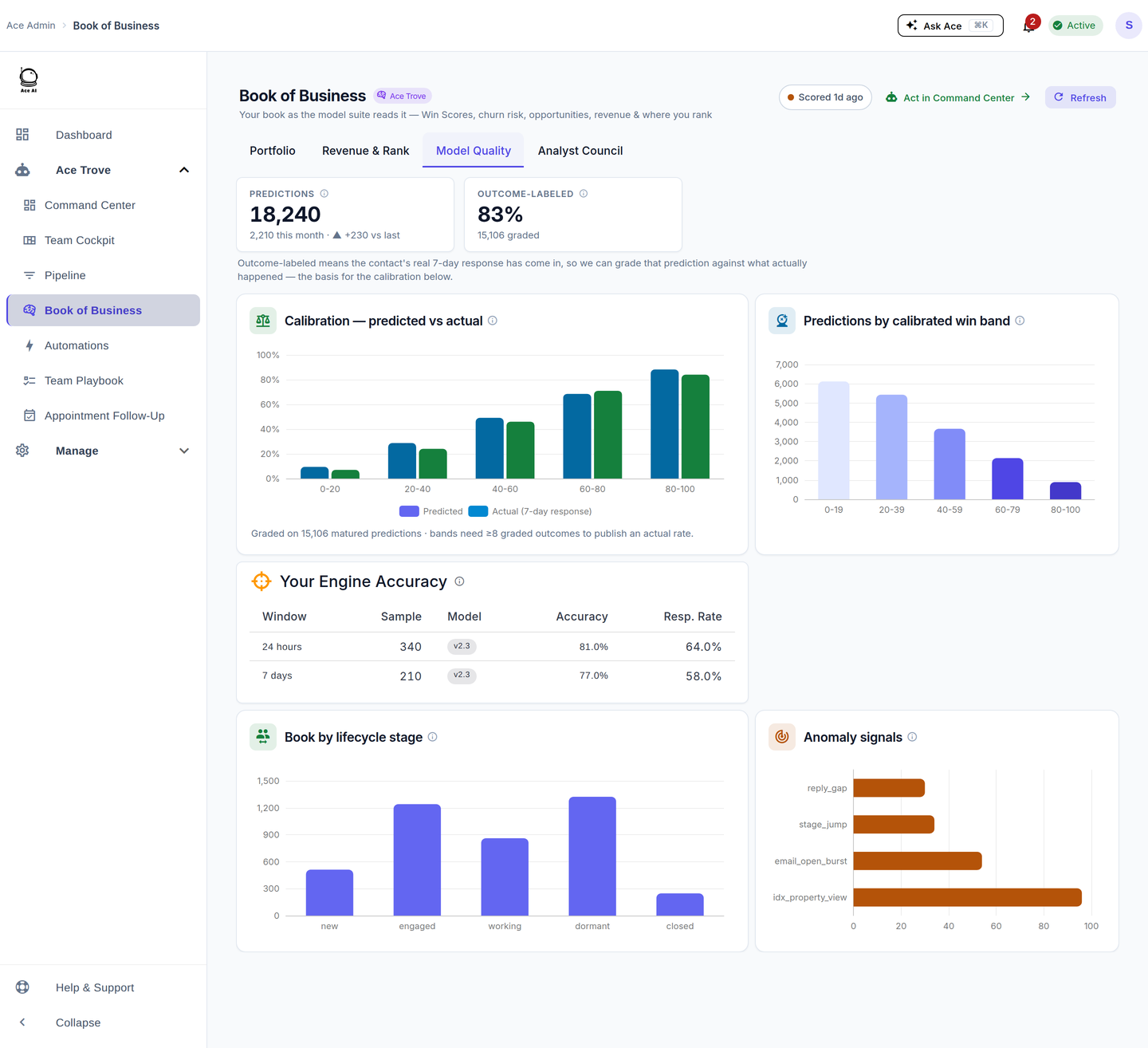
Predictive lead scoring for real estate is the practice of ranking every contact in a CRM by their probability of converting — based on behavioral patterns from real pipeline outcomes, not static rules. The Ace Trove does this by streaming every Follow Up Boss event into a data warehouse, scoring the whole book with a suite of seven predictive models (win, response, churn, appointment propensity, a full-population fallback, and buyer-track/seller-track propensity), checking predictions against what actually happened 24 hours and 7 days later, retraining the models weekly, and re-calibrating so the stated probability reflects the empirically observed rate.
Most "AI lead scoring" in real estate is a spreadsheet formula wearing a model's name. A contact gains points for opening an email, loses them for going quiet, and the weights never change. The deeper problem isn't the simplicity — it's that no one ever checks the math. No vendor will tell you whether the leads it scored 90 actually closed more often than the ones it scored 40, because most of them have never looked. A score you can't audit against outcomes isn't a prediction. It's a guess with a decimal point.
The Ace Trove makes the opposite bet: build the score on a foundation that can be checked. It starts with a streaming data warehouse, then corrects every score against real outcomes each night, so a stated close probability is adjusted to match the rate at which contacts with that score actually closed. This post explains how that works, what it powers today, and what it honestly doesn't do yet.
What is predictive lead scoring in real estate, and why does calibration matter?
Predictive lead scoring ranks leads by their likelihood of converting — but a score is only useful if it means the same thing every time you look at it. Calibration is the practice of checking whether a model's stated probabilities match observed rates. If the model says "70% close probability" and that cohort closes at 30%, the model is confidently wrong. Re-calibrating nightly against real outcomes is what closes that gap.
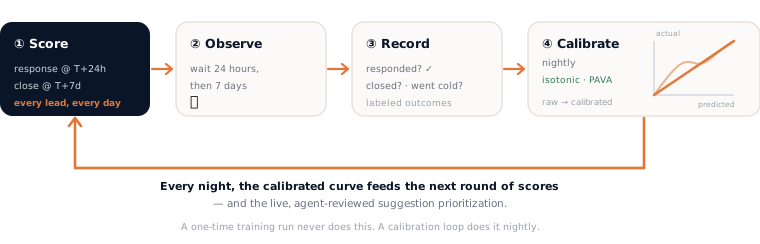
The Ace Trove uses isotonic regression — the pool-adjacent-violators algorithm, or PAVA — to correct the model's raw probability output. Isotonic regression does one disciplined thing: it stretches and compresses the raw probabilities until they line up with the rates your pipeline actually produced, never changing their order, only their honesty. So the number you see reflects what your pipeline did, not what a training dataset produced on someone else's data. This is not a static model that ships once and never updates. It is a live calibration loop: every deal your team closes or loses becomes another data point the next night's pass learns from.
How does Ace Trove's data warehouse work?
Ace Trove is powered by a streaming data warehouse. Every event in your Follow Up Boss account — calls, texts, emails, notes, stage changes, deals opened, deals closed — is streamed continuously into a raw landing layer as it happens. From there a transformation pipeline produces a clean analytics layer. That analytics layer is what the scoring model, revenue calculations, and benchmark queries all run against.
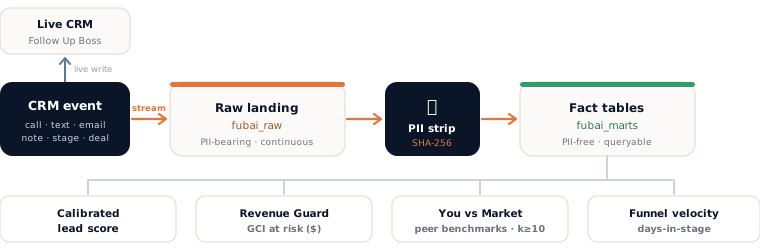
Here is how the architecture flows, from CRM event to actionable insight:
- Event stream. A contact receives a call, a stage changes, a deal closes. That event is written to Firestore (your CRM's live database) and simultaneously streamed into the raw landing layer of the warehouse. The write path is continuous — not a nightly batch, not a weekly sync.
- PII stripping. Before any event lands in the analytics layer, personal information is removed. Names, email addresses, and phone numbers are dropped entirely; account IDs, contact IDs, and agent IDs are replaced with SHA-256 hashes. Nothing that can identify a person reaches the query layer.
- Fact tables. The transformation layer builds structured fact tables: deal pipeline snapshots, stage-transition records, activity counts, and prediction outcomes. These are what the model and analytics queries read from.
- Nightly prediction labeling. A scheduled job looks back at predictions made at T+24h and T+7d and records what actually happened — did the contact respond? Did the deal advance? Did it close or go cold? These labeled outcomes become the training signal for the next calibration pass.
- Calibration rollup. Each night, the calibration job runs isotonic regression over the labeled prediction dataset and adjusts the model's probability output so the stated score matches the observed rate from your actual pipeline data.
- Weekly retraining. The labeled training data grows as new leads arrive and deals close. Each of the seven models is retrained and re-evaluated on fresh held-out data weekly — and a retrained candidate only replaces the deployed model if it evaluates at least as well. The methodology and current numbers are published in the model evaluation report.
- Cost and safety guards. Every warehouse query carries a hard byte ceiling and a query timeout — a runaway query is killed by the warehouse, not absorbed as cost — and results are cached so routine requests never touch the warehouse directly. A kill-switch can disable the entire warehouse tier instantly, and the CRM keeps running without it.
What does Ace Trove produce today?
Four analytics surfaces are live and code-verified today. Each one is a downstream product of the same warehouse and calibration infrastructure described above.
1. Calibrated predictive lead scoring — a five-model suite
Every contact in your Follow Up Boss book — the whole book, not a sample — is scored by a suite of seven predictive models: the probability of converting to a closed deal (the calibrated 0–100 Win Score), the probability of responding to outreach, the risk an engaged contact goes cold (Churn Risk), appointment propensity, a full-population fallback conversion model that covers the contacts whose history is too thin for the headline models to read confidently, and buyer-track/seller-track propensity models that flag which side of a transaction a contact is likely on. The models are retrained weekly on your market's fresh outcomes, the full scored population refreshes on a rolling weekly pass, and updated scores land on contacts and Follow Up Boss fields nightly.
The predictions are then graded against two horizons: did the contact respond within 24 hours (T+24h)? Did they stay engaged — respond or book an appointment — versus go cold over 7 days (T+7d)? Closed-won outcomes feed a separate, longer-horizon calibration track. The stated probabilities are re-calibrated against those observed rates — not a static output from a one-time training run.
Two things happen with that calibrated number. First, it feeds your live prioritization: the contact-value score that decides which leads Ace surfaces as proactive, agent-reviewed suggestions is computed from the calibrated probability, not the raw model output, so the ranking reflects what your pipeline actually converts. Second — and this is the part no rules-based scorer can match — you can check it. The team accuracy view shows how the model's stated probabilities have tracked against real outcomes in your own market. When the model says 70%, you can see whether that cohort actually closed near 70%. There is something to check, and it is shown to you. And for the suite as a whole, we publish the evidence: held-out evaluation numbers for every one of the seven models, with an honest explainer of what they do and don't mean, in the model evaluation report.
2. Revenue Guard — GCI at risk in real dollars
Revenue Guard calculates the gross commission income at risk from deals that are stalling or going cold, denominated in real dollars. The dollar figure is anchored to the account's own median commission per closed deal — pulled from the deals already closed on your account, not an industry average or a national figure. If your team's median commission is different from the market average, the calculation reflects that. Revenue Guard is an early-warning tool, not a revenue forecast: it identifies which specific deals in your current pipeline are in danger of slipping, and puts a real dollar figure on what's at stake if they do.
3. You vs. Market — anonymous peer benchmarks
You vs. Market gives you anonymous peer percentiles: your win rate and median GCI-per-deal compared to accounts in the same size tier. The comparison is honest about how it protects privacy. Ace Trove enforces k-anonymity with a minimum cohort size of 10 — a peer benchmark only appears when at least 10 separate accounts are in the comparison group. Cohorts with fewer than 10 accounts are suppressed entirely, and aggregate rates are rounded to prevent inference from small samples. On top of k-anonymity, every account ID and contact ID in the analytics layer is SHA-256 hashed. There is no path from a peer benchmark back to a named account.
4. Lead Funnel velocity
Lead Funnel velocity shows stage-to-stage conversion rates and median days-in-stage across your active pipeline — pulled from the same fact tables as the scoring model. This is your pipeline's actual cadence, not a benchmark derived from someone else's CRM. It surfaces where deals are stalling: if contacts typically spend three days in the "Appointment Set" stage but your current pipeline shows ten days, that's a flag. The velocity view works from your own historical pipeline data and refreshes as new deals close.
How does AI lead scoring in real estate compare to Follow Up Boss's native reporting?
Follow Up Boss includes strong built-in reporting — pipeline views, team leaderboards, source tracking, and contact activity history. These are operational tools built for running the business day-to-day, and they are genuinely good at it. The Ace Trove adds an analytical layer on top: predictive outputs, outcome calibration, and cross-account benchmarks that require a data warehouse to compute. Here is an honest side-by-side of what each does:
| Capability | Native Follow Up Boss | Ace Trove |
|---|---|---|
| Pipeline & deal reporting | Yes — core CRM feature | Reads from FUB pipeline |
| Team leaderboards & activity logs | Yes | No — use FUB natively |
| Source attribution & ROI | Yes — built in | Complements via deal data |
| Calibrated predictive lead score | No | Yes — nightly calibration |
| GCI at-risk (Revenue Guard) | No | Yes — anchored to your median commission |
| Anonymous peer benchmarks | No | Yes — k=10 enforced |
| Stage-to-stage velocity & median days | Basic pipeline view | Yes — from warehouse fact tables |
| Outcome labeling & model calibration | No | Yes — nightly against T+24h/T+7d outcomes |
| PII in analytics layer | N/A (CRM stores PII) | None — PII stripped; IDs SHA-256 hashed |
Follow Up Boss is a well-built CRM with strong reporting for day-to-day operations. The Ace Trove adds analytical layers that require a separate data warehouse — it does not replace FUB's reporting; it computes things FUB's architecture isn't designed to compute.
What Ace Trove's analytics layer doesn't do yet (the honest scope)
We opened by saying most scorers are never checked against an outcome. Here is where ours is still catching up — stated plainly, because a scorer that hides its limits is exactly the thing we're arguing against.
- Calibration needs your outcomes before it sharpens. The calibrated probability only improves on the raw model once your account has logged enough T+24h and T+7d results for the nightly rollup to build a calibration table. Until then — on a brand-new account, or in a thin market segment — scoring falls back to the raw model probability and degrades gracefully, exactly as it behaved before calibration existed. The loop gets more accurate the more your pipeline runs; it does not start out perfect.
- No lead-to-closed cohort conversion benchmarks yet. The warehouse includes the structures to compute cohort conversion funnels across accounts, but the underlying activity records aren't yet reliably linked to individual contacts — so those funnels would be computed on incomplete data. We've left the feature switched off rather than show numbers we don't trust, and we won't market it as live until that's fixed.
- Revenue Guard uses your own commission median, not a market average. This is a deliberate design choice — and a limitation if you don't yet have closed deals on the account. Without enough historical closed deals to compute a median, Revenue Guard cannot produce a dollar figure for that account.
- Peer benchmarks require cohort minimums. If you are in a niche market segment or a very small account size tier, the k-anonymity requirement (minimum cohort of 10) may suppress peer benchmarks until enough accounts populate that cohort. The suppression is intentional and non-negotiable — it protects all accounts including yours.
Frequently asked questions about AI lead scoring for real estate
What is predictive lead scoring in real estate?
Predictive lead scoring in real estate ranks every lead and contact in a CRM by their probability of converting — based on patterns from real pipeline outcomes, not static rules. A calibrated model checks its predictions against what actually happened (did the lead respond? did the deal close?) and adjusts its weights accordingly. The result is a score that improves over time as more outcomes are recorded, rather than a rules-based rank that stays fixed until someone edits the weights manually.
How does the Ace Trove score leads in Follow Up Boss?
Ace Trove streams every Follow Up Boss event into a data warehouse continuously. A suite of seven predictive models scores every contact in the book — win probability, response probability, churn risk, appointment propensity, a full-population fallback for thin-history contacts, and buyer-track/seller-track propensity. Predictions are checked against actual outcomes — did the contact respond within 24 hours? Did they stay engaged or go cold within 7 days? — the models retrain weekly on fresh outcomes, and calibration is re-fit using isotonic regression so the stated probability reflects the observed rate in your pipeline, not a fixed training-set output. Each model's held-out evaluation numbers are published in the model evaluation report.
Does AI lead scoring actually work?
AI lead scoring works when it is calibrated against real outcomes and fails when it isn't. A scoring rule that never checks itself can rank leads in a confident-looking order that has no relationship to who actually closes. A calibrated model is different: it compares every prediction to what really happened — did the contact respond, did the deal close — and corrects itself, so a stated probability reflects a real observed rate. That is why the Ace Trove surfaces its own calibration accuracy on your own pipeline instead of asking you to take the score on faith.
What is Revenue Guard in real estate analytics?
Revenue Guard is the Ace Trove feature that calculates the GCI at risk from stalling or cold deals — denominated in real dollars from your account's own closed-deal commission median. It is an early-warning tool, not a revenue forecast: it identifies which specific deals are in danger of slipping out of the pipeline this cycle and what walking away from them costs, in dollar terms that match your own market's commission structure.
How does Ace protect my data when computing peer benchmarks?
Ace enforces k-anonymity with a minimum cohort size of 10 accounts before any aggregate is shown — a peer benchmark is suppressed entirely if fewer than 10 accounts are in the comparison group. In addition, the analytics layer never carries names, emails, or phone numbers at all, and every account and contact identifier is SHA-256 hashed before any cross-account query runs — so there is no path from a benchmark result back to a named account. Small-cohort rate-rounding adds a further layer of inference protection on top of the size floor.
Does Follow Up Boss have built-in lead scoring or revenue analytics?
Follow Up Boss has strong operational reporting built in — pipeline views, team leaderboards, and source attribution. It does not include calibrated predictive lead scoring, GCI-at-risk calculations anchored to your own commission data, or anonymous peer benchmarks. Those require a streaming data warehouse and outcome-labeling infrastructure that the Ace Trove adds on top of the CRM you already use, without any data migration or second login.
Try Follow Up Ace in your Follow Up Boss
Free to start, no sales call. Connect Follow Up Boss in one click and Ace Trove starts working on your pipeline — calibrated lead scores, Revenue Guard, peer benchmarks, and funnel velocity. You see the scores, and the model's accuracy on your own deals, from day one.
Get Started Free