How Automated Follow-Up Sequences Work in Follow Up Boss
Automated follow-up sequences in Follow Up Boss are called Action Plans — multi-step workflows combining emails, texts, task reminders, and phone call prompts. They trigger automatically based on lead source, stage change, tag, or smart list membership, and run in the background so agents never miss a touchpoint.

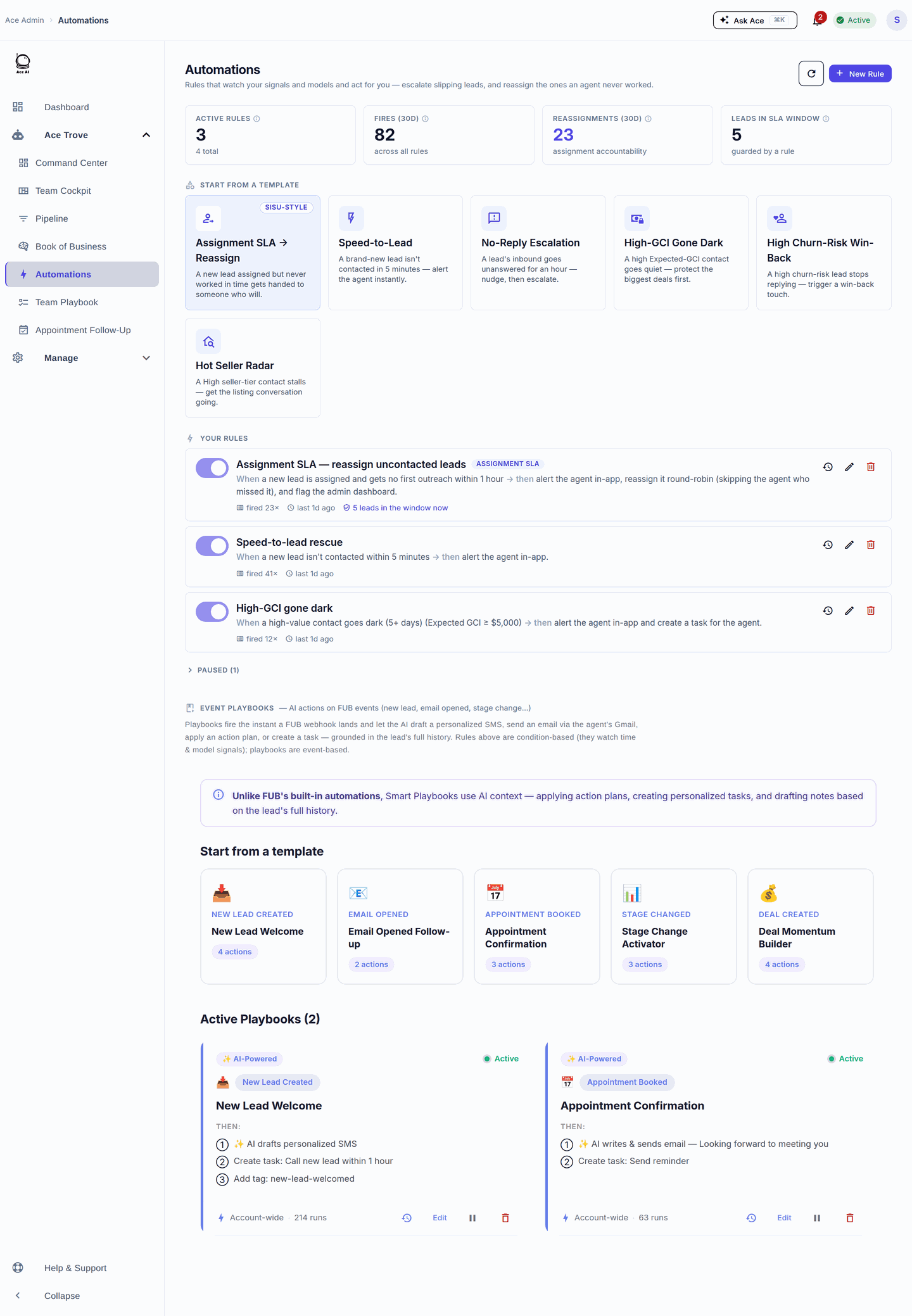
What Are Automated Follow-Up Sequences in Follow Up Boss?
In Follow Up Boss, automated follow-up sequences are built using a feature called Action Plans. An Action Plan is a pre-programmed series of steps — emails, text messages, task reminders, and phone call prompts — that runs automatically after a lead is assigned to it. Once configured, the plan fires each step at the scheduled time without any manual effort from the agent.
Action Plans are the backbone of lead nurture inside FUB. Think of them as a playbook that runs itself: each step has a defined delay (send an email 1 hour after assignment, create a call task on day 3, send a follow-up text on day 7), a channel (email or SMS), and optional message templates you fill in once.
Action Plans vs. traditional drip campaigns
Traditional drip campaigns are purely time-based — they send message #1 on day 1, message #2 on day 4, regardless of what the lead does. FUB Action Plans go further. They can include task steps (manual reminders for agents), phone call prompts, and note steps — turning the sequence into a full activity workflow, not just an email queue. The lead's engagement or stage change can also pause or redirect them to a different plan.
- Email steps — personalized email messages sent on a schedule you define
- Text steps — automated SMS touchpoints (requires Twilio integration in FUB)
- Task steps — agent to-do reminders ("Call lead to introduce yourself")
- Phone call steps — prompts in the FUB dialer queue at a scheduled time
- Note steps — internal notes logged to the contact record automatically
How Action Plans Are Triggered in Follow Up Boss
Action Plans can be triggered four different ways in Follow Up Boss. Understanding each trigger method helps you design sequences that fire at the right moment — not too early, not too late.
Manual assignment is the simplest: an agent or admin opens a contact record and selects "Add to Action Plan" from the contact toolbar. This is ideal for one-off nurture or when you want agent judgment before automation starts.
Lead source routing lets you configure FUB to automatically apply an Action Plan whenever a lead arrives from a specific source — Zillow, realtor.com, a website form, or any other integration. You set this in Admin > Lead Routing, pairing source tags with plans.
Stage changes are one of the most powerful triggers. When a lead moves from "New Lead" to "Contacted," or from "Nurture" to "Active Buyer," FUB can automatically switch them to a new Action Plan matching that stage. This keeps the content relevant as the relationship deepens.
Smart list membership is the most dynamic trigger. Smart lists filter your database in real time by any criteria — last contacted date, lead stage, source, tags, custom fields. When a lead lands on a smart list that has an Action Plan configured, FUB enrolls them automatically. As leads move off the list, their plan can pause or stop.
| Trigger Type | How to Set It Up | Best For |
|---|---|---|
| Manual assignment | Contact record → "Add to Action Plan" | Re-engaging past clients, one-off nurture |
| Lead source routing | Admin → Lead Routing → assign plan by source tag | New inbound leads from specific portals |
| Stage change | Admin → Stages → set Action Plan per stage | Moving buyers/sellers through the pipeline |
| Smart list membership | Smart Lists → filter criteria → attach Action Plan | Database reactivation, dormant lead segments |
Step-by-Step: How to Build an Automated Follow-Up Sequence in FUB
Building your first Action Plan takes about fifteen minutes. Here is the exact path through the Follow Up Boss admin interface.
- Navigate to Admin > Action Plans. In the left sidebar of your FUB dashboard, go to Admin, then select Action Plans. Click "New Action Plan" in the top right.
- Name the plan clearly. Use a descriptive name like "Zillow Buyer — First 30 Days" or "Warm Seller Nurture." Good names make it easy to audit which contacts are on which plan later.
- Add your first step. Click "Add Step" and choose the step type — email, text, task, phone call, or note. Set the delay (e.g., "immediately" or "1 day after enrollment") and fill in the message template or task description.
- Build out the sequence. Continue adding steps. A typical new-lead plan might have: an immediate text, an email within 1 hour, a call task on day 2, a follow-up email on day 4, and a longer nurture email on day 7.
- Set email and text templates. For each message step, either write the content inline or select a saved template from your FUB template library. Use merge tags (like
{{first_name}}) to personalize automatically. - Configure sending hours. FUB lets you restrict when automated texts and emails go out (e.g., no messages before 8 AM or after 8 PM local time). Set this to avoid contacting leads at inappropriate hours.
- Save and publish the plan. Click "Save." The plan is now available for assignment — either manually, via lead routing, or through a smart list.
Best Practices for Follow-Up Sequence Timing
Timing is the most important variable in follow-up sequences. Industry best practice is consistent: speed to lead matters enormously, especially for inbound internet leads. The first response should happen within minutes, not hours. Here is a framework that has held up across thousands of real estate teams.
- Immediately (within 5 minutes): Automated text — short, direct, confirms receipt and asks a qualifying question ("Hi [name], just got your inquiry about [address]. Is this property still on your radar?")
- Within 1 hour: Email — slightly more detailed, introduces the agent and offers value (neighborhood report, saved search setup)
- Day 1–2: Phone call task — a manual reminder for the agent to actually call; automation handles reminders but the human conversation closes the deal
- Day 3–4: Second email — content-forward (market snapshot, related listings)
- Day 7: Follow-up text — casual check-in, low pressure
- Day 14, 21, 30: Monthly nurture emails — market updates, home value content, relationship maintenance
Personalize subject lines with the lead's first name and a relevant property address or neighborhood when possible. Generic subject lines ("Following up with you!") get filtered or ignored. A subject line like "3 homes under $500K in Highlands Ranch — still searching?" performs meaningfully better.
Review your send-time windows regularly. If most of your leads are in a timezone different from your server's, make sure FUB's send window is localized so messages land in the morning, not at 3 AM.
How Ace Trove Makes Follow-Up Sequences Smarter
Follow Up Ace's Ace Trove sits on top of your Follow Up Boss data and adds a layer of intelligence that standard Action Plans can't provide on their own. Instead of treating every lead the same, Ace scores and tiers each contact — so you always know which Action Plan to reach for first.
Ace Score and Ace Tier — prioritize smarter
Every contact in your FUB account receives an Ace Score (0–100) and an Ace Tier (Hot, Warm, Cool, Cold, or Dormant). These are webhook-driven custom fields that update automatically as lead activity changes. Instead of running a generic drip campaign to your entire database, you can build smart lists that segment by Ace Tier and assign the right-intensity Action Plan to each segment — an aggressive 10-step sequence for Hot leads, a lighter monthly nurture for Dormant ones.
Lead Nurture Optimizer — re-engagement suggestions
Ace includes a lead-nurture-optimizer tool that scans your database for cold contacts who have gone quiet and recommends personalized re-engagement approaches. Rather than guessing which message to send to a lead who hasn't responded in 60 days, Ace analyzes their history and surfaces a suggested action — a specific message angle, a channel recommendation, or a note about timing. This complements your Action Plans by flagging the gaps your current sequences aren't catching.
Ace Preferred Channel — email vs. text
Ace tracks an Ace Preferred Channel field for each contact, indicating whether they tend to respond better to email or text. When you're deciding whether to lead a sequence with a text or an email, check the Preferred Channel field first. Sending the wrong medium is one of the most common reasons follow-up sequences underperform.
Fair Housing compliance scan
Before you finalize your Action Plan templates, run them through Ace's compliance scanner. The scanForComplianceViolations() function checks message copy for language that could create Fair Housing liability — protected class references, discriminatory framing, or steering language. It's a fast, automated review you can run on every template before it goes live. This is especially important when Action Plans run without agent review on every send.
Ace also tracks Ace Velocity Score, Ace Response Time, and Ace Days Since Inbound — all of which can inform smart list filters that trigger or adjust Action Plans based on real engagement behavior, not just elapsed time. Learn more about the full suite of agentic AI tools available in Ace.
Common Mistakes That Kill Follow-Up Sequence Performance
Even well-configured Action Plans fail when common errors creep in. Here are the mistakes that come up most often — and how to fix them.
Generic templates with no personalization. If every email starts "Hi there, I'm a real estate agent and I'd love to help you," it will feel like spam — because it is. Use merge tags for name, property address, and neighborhood. Reference the specific source the lead came from when possible.
Too many steps too close together. Sending three emails in the first 48 hours trains recipients to ignore you — or unsubscribe. Front-load the sequence with high-value touchpoints, then space out later steps. Let engagement (or non-engagement) inform the cadence.
Forgetting to pause sequences when a lead becomes an active client. Nothing damages trust faster than receiving a "Hi, I noticed you were looking at homes — are you still searching?" text from an agent you've already signed a buyer agreement with. Build a clear offboarding step into your pipeline: when a lead moves to "Active Buyer" or "Under Contract," stop the nurture Action Plan immediately.
Never reviewing open or reply rates. FUB's reporting shows which Action Plans are generating replies and engagement. Audit your plans monthly. A sequence that nobody replies to isn't nurturing — it's noise. Trim, personalize, and test subject lines until the numbers move.
Using one plan for every lead source. A Zillow buyer who clicked on a specific listing needs different messaging than a seller lead who filled out a home valuation form. Segment your plans by source and intent. The extra setup time pays off in relevance — and relevance drives replies.
Frequently Asked Questions
Can Action Plans in FUB send texts automatically?
Yes. Follow Up Boss integrates with Twilio to send automated SMS messages as part of an Action Plan. You need to have your Twilio integration configured in FUB Admin settings and your phone number verified. Once set up, text steps in an Action Plan fire automatically on the schedule you set, within any send-time windows you configure.
How many Action Plans can I have in Follow Up Boss?
FUB does not publish a hard cap on the number of Action Plans you can create. In practice, high-performing teams maintain 10–20 plans covering different lead sources, stages, and personas (buyer vs. seller, short-term vs. long-term). More than that tends to become difficult to audit and maintain. Quality over quantity is the right approach here.
What happens if a lead is on two Action Plans at the same time?
A contact in Follow Up Boss can technically be enrolled in multiple Action Plans simultaneously, though this is generally not recommended. Overlapping plans can result in duplicate messages or conflicting tasks. Best practice is to use stage changes to transition a lead from one plan to another, automatically stopping the old plan when the new one starts.
Do Action Plans stop when a lead replies?
By default in FUB, an Action Plan does not automatically pause when a lead replies to an email or text. You can configure this behavior — FUB has a "pause on reply" option for sequences — but you need to enable it explicitly. Many teams enable this so that once a real conversation starts, automated messages don't interrupt it. Review your Action Plan settings in FUB Admin to confirm how each plan is configured.
How does Follow Up Ace connect to Action Plans?
Follow Up Ace writes custom fields (Ace Score, Ace Tier, Ace Preferred Channel, and others) directly into Follow Up Boss via webhook. You then use those fields as smart list filters to drive Action Plan enrollment. For example, a smart list for "Ace Tier = Cold AND last contacted more than 30 days ago" can automatically enroll contacts into a re-engagement Action Plan. Ace also surfaces pipeline gaps through its agentic AI tools — explore the full learning guides to see how teams wire this together.
Try Follow Up Ace in your Follow Up Boss
Free to start, no sales call. Connect Follow Up Boss in one click and Ace works inside your CRM.
Get Started Free