Cross-Platform Notifications in Follow Up Boss
Follow Up Boss delivers notifications across web, iOS, and Android for new leads, texts, emails, and tasks. As of July 2026, Follow Up Ace adds 11 alert categories with independent push/email toggles, quiet hours that demote push instead of dropping it, and one locked channel — account and security email — that can never be muted.
What types of notifications does Follow Up Boss send?
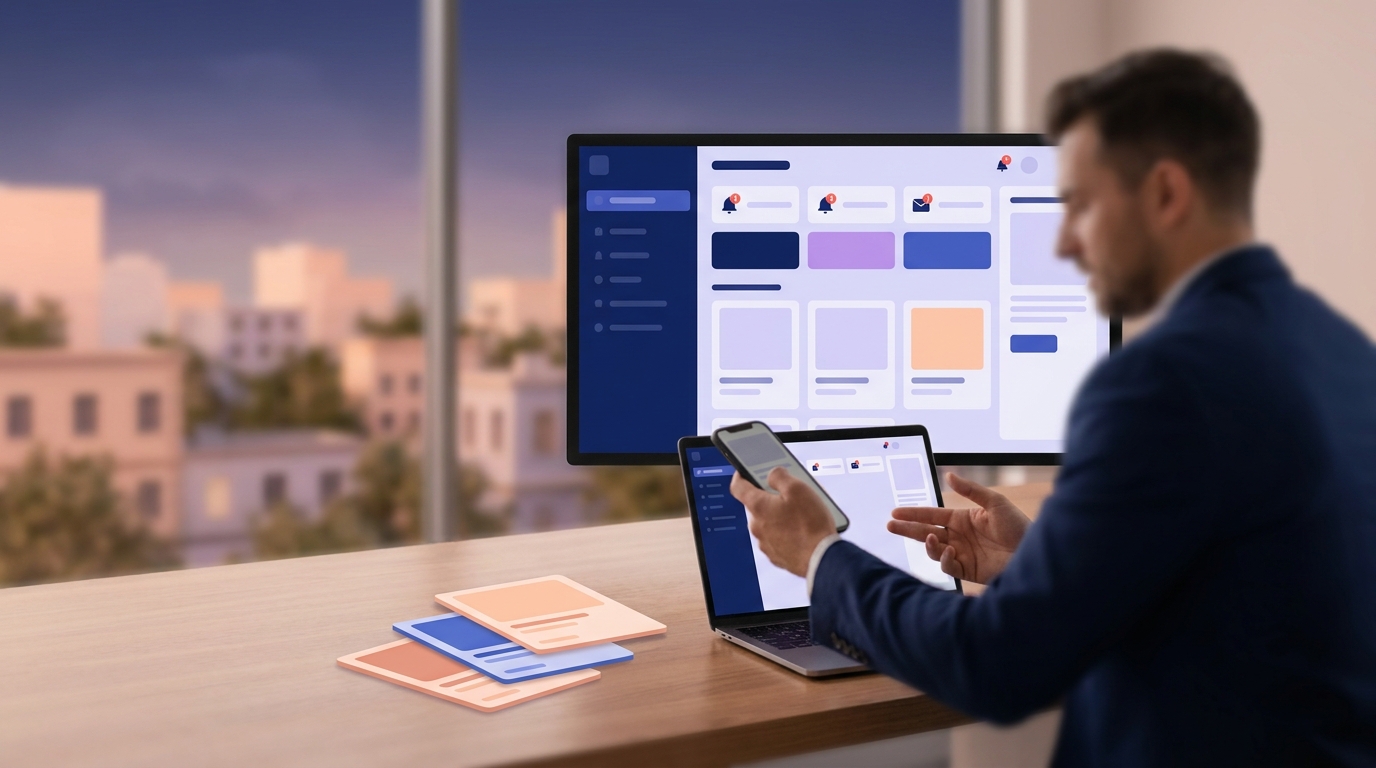
Follow Up Boss is designed around the reality that real estate agents are mobile — in the car between showings, on a property walk, away from a desk. Its notification system reflects this by delivering time-sensitive CRM events across the device the agent is most likely to have with them.
The core notification types include:
- New lead notifications — instant alerts when a new lead is assigned, with lead source and contact details
- Inbound text and email notifications — alerts when a contact replies to an SMS or email sent through FUB
- Task reminders — scheduled task due dates surfaced as in-app and push notifications
- Action plan step notifications — when an action plan triggers a task, call, or message step for an agent
- Appointment reminders — calendar-based push reminders before scheduled showings or calls
- Lead routing notifications — when a pond lead is available and the agent can claim it
Does Follow Up Boss have mobile apps for notifications?
Yes. Follow Up Boss has native iOS and Android apps that receive push notifications for new leads, inbound texts and emails, and task reminders. Agents can use the mobile app to call, text, and email contacts directly — keeping all activity logged in the CRM — and receive the same real-time notification stream they would get on desktop.
Mobile push ensures that a lead who texts at 8 pm reaches the agent instantly rather than sitting unread until the next morning. Given that speed-to-lead is one of the highest-leverage behaviors in real estate sales, mobile push notification support is a core function, not a convenience feature.
How do notification settings work for teams in Follow Up Boss?
FUB allows individual agents to manage their own notification preferences for categories like new leads, inbound contacts, and task reminders. Admins can configure team-wide settings for routing and escalation behavior but cannot force notification delivery to a specific agent's phone — the agent controls their own device preferences.
This creates a practical challenge: an admin may configure excellent lead routing, but if an agent has silenced new-lead push notifications, the speed-to-lead improvement is blocked at the device level. Understanding this gap is important for teams trying to drive consistent response times.
What are AI-driven agent alerts and how do they differ from standard FUB notifications?
Standard FUB notifications tell you what happened: a new lead arrived, a contact texted back, a task is due. They are reactive — you only get them if the CRM event occurred.
AI-driven alerts tell you what is at risk: a contact who reached out has been waiting for 26 hours without a reply; a top-scoring lead hasn't had a logged touch in seven days. These require analysis of patterns across the CRM, not just event delivery.
Follow Up Ace generates this second layer of alerts. Alert types include:
| Alert type | What triggers it | Re-alert cadence |
|---|---|---|
| Contact waiting — urgent | Contact has been waiting for an agent reply; threshold exceeded | Every 4 hours if still waiting |
| Contact waiting — critical | Contact waiting more than 24 hours without a reply | Every 2 hours |
| Hot lead untouched | Top Win Score band with no logged outreach in 7+ days | Recomputed each time the dashboard loads |
| Performance dormant | Agent has been inactive for 7 or more days | Every 48 hours |
| Appointment debrief | Appointment ended — AI asks the agent how it went to capture meeting context | Once per appointment |
| Seller likely listed | A contact flagged as a seller has property data suggesting they may have listed or sold | Once (not repeated) |
The contact-waiting cadences above are the first re-alert; that window doubles on each repeat. The other rows fire on the fixed schedule shown, or — for the hot-lead row — are recomputed on demand rather than re-alerted at all.
Most of these alerts go to both the assigned agent (in-app) and the admin (accountability dashboard) — the hot-lead-untouched row is computed for the admin alert feed specifically and isn't pushed to the agent as a standing alert. The deduplication cadence prevents alert fatigue — a contact waiting urgently starts re-alerting every four hours, not every five minutes, and that window doubles on each repeat if nobody acts (four hours, then eight, then sixteen), so a long-ignored alert backs off rather than spamming the same phone all night.
Per-category notification controls, quiet hours, and the locked account-security channel (shipped July 2026)
Before this shipped, notification behavior in Ace was spread across four places that didn't know about each other — a hardcoded push module, a 12-value alert-type enum, roughly 18 ad-hoc alert strings scattered through workflow, playbook, Zillow, seller, and lead-magnet code, and a single browser-permission checkbox in Companion Settings. The practical result: an agent could not turn any single kind of alert off (the only lever was the OS-level "disable notifications for this app," which is all-or-nothing and costs you speed-to-lead), and most alerts never reached a closed app at all — only one code path called push directly, so the other ~20 alert types sent a socket update and nothing else. If the app was backgrounded, the agent found out later, or not at all.
That's now consolidated into one catalog and one decision function. There are 11 notification categories, each with its own push, email, and in-app defaults:
| Category | Push | Can pierce quiet hours? | |
|---|---|---|---|
| New leads | On | Off | Yes (urgent) |
| Someone is waiting on you | On | Off | Yes (urgent) |
| Hot lead signals | On | Off | No |
| Ace drafted something | On | Off | No |
| Follow-ups slipping | On | Off | No |
| Appointments | On | Off | No |
| Deals at risk | On | Off | No |
| Seller signals | On | Off | No |
| Automations & handoffs | On | Off | No |
| Coaching & performance | Off | Off | No |
| Account & security | Off | On & locked | Always (locked channel) |
Email is off by default for every alert category — the one exception is the transactional Account & security channel, which ships email-on because it can't be muted. Installing Ace shouldn't fill an inbox — each category's email is a single toggle away for agents who want the paper trail, and every notification email carries a genuine one-click opt-out link, honoring the same standard corporate link scanners and mail prefetchers expect (the visible footer link goes through a one-tap confirm page precisely so a scanner GET request can't silently unsubscribe someone who never clicked anything).
How quiet hours actually behave
The delivery decision for every single alert — push or email — runs through one function, evaluated in a fixed order: a channel the agent switched off is suppressed; an active hard pause suppresses everything, including urgent categories, because a "stop for an hour" that new leads punched straight through wouldn't be worth offering; then quiet hours apply. During quiet hours, push demotes to silent — the app still receives the data and updates its state, but the phone doesn't buzz. Email behaves differently: there's no silent email, so a quiet-hours email in a non-locked category is dropped outright rather than held for later — which mostly matters for agents who've turned a category's email on, since it's off by default everywhere except the one locked channel. The two categories marked urgent above (new leads, someone waiting on you) ring through quiet hours unless the agent has explicitly turned off "allow urgent" in their own settings. Quiet hours are evaluated per device, on that device's own clock, so a work phone in Denver and an iPad in Miami are each judged on their own local time rather than a shared account setting.
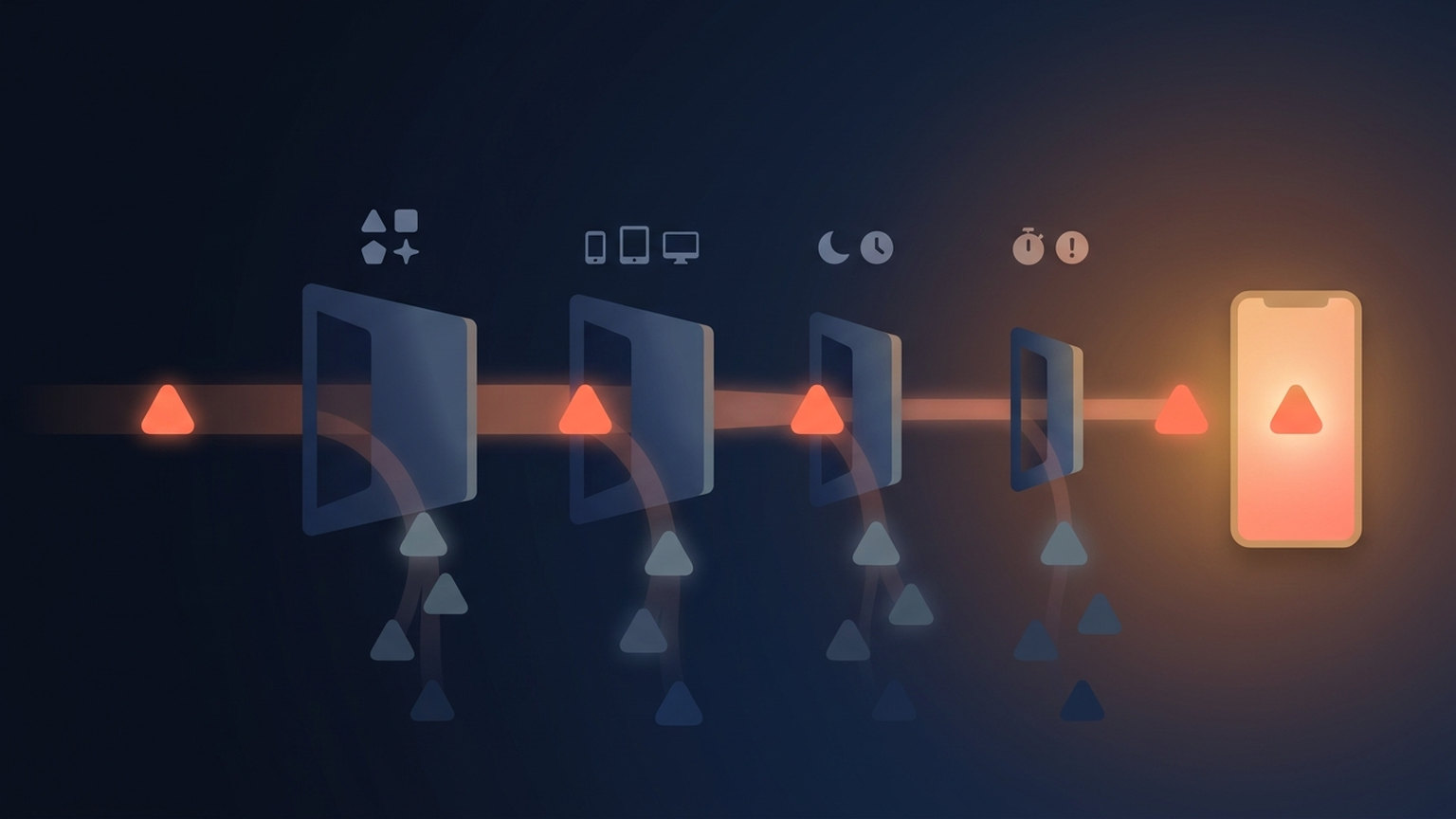
The delivery decision, in order: channel off → hard pause → quiet hours → urgent override.
One category cannot be muted at all: Account & security email is locked on. A password reset or a billing notice raised at 10pm used to get silently swallowed by quiet hours — there's no retry queue for a dropped transactional email, and no way for the agent to learn it never arrived. A locked channel that quiet hours could still mute wasn't really locked, so it's now the one channel every suppression rule skips entirely.
All of this lives in the same Companion Settings panel covered in the Companion + Chrome Bridge rollout, and reaches the same devices registered for push through the Follow Up Boss iPhone app — the control panel and the delivery pipe are the same system whether the notification lands on a phone, a tablet, or in an inbox.
What is notification opportunity detection?
Beyond individual agent alerts, Follow Up Ace runs a notification opportunity detection layer that analyzes team-level patterns. This surfaces situations that no single agent-level alert would catch:
- Team score drops — if the team's aggregate score drops below a configurable threshold (default warning at 60/100, critical at 40/100), an admin alert fires
- High-intent contacts left waiting — warning at 15 minutes, critical at 60 minutes
- Revenue at risk — seat spend going to waste on ghost seats and inactive agents, with configurable dollar thresholds (default warning $100/mo, critical $500/mo)
- Milestone achievements — agents scoring 90+ on their accountability score, surfaced as recognition opportunities for managers
Thresholds for all of these are configurable by admin, so a brokerage with a fast-moving market can set more aggressive response-time SLAs than a quieter rural team.
How does the appointment debrief alert work?
When an appointment ends — as detected from the FUB calendar and appointment data — Follow Up Ace generates an appointment debrief alert for the assigned agent. The AI prompts the agent to capture how the showing or call went: what the client's reaction was, what objections came up, what the next step is.
This turns a routine post-appointment moment into a structured data-capture event. The debrief is logged as a note in FUB, so the context lives on the contact record for whoever touches that lead next. An agent who consistently debriefs their appointments builds a contact record that is genuinely useful for the next person who picks it up.
How does admin visibility differ from agent notifications?
Agents receive alerts relevant to their own assigned contacts: contacts waiting for their reply, appointment debriefs, and a dormant contact who just re-engaged on a listing or email. Admins receive the same alerts plus team-level roll-ups: which agents are underperforming, and which seats are burning subscription spend while sitting inactive.
The accountability dashboard in Follow Up Ace consolidates this into a single view — part of the account-wide Ace Trove Command Center. An admin reviewing the dashboard on Monday morning sees the full landscape — who is performing, where coverage gaps exist, and which specific contacts need escalation — without having to pull individual agent reports.
What notification practices have the most impact on team performance?
- Ensure mobile push is enabled on every agent's device. All the notification infrastructure in the world is useless if an agent has silenced push from FUB on their phone.
- Set realistic response time SLA thresholds and communicate them. Configuring the alert system to match your actual team expectations prevents both alert fatigue (too aggressive) and blind spots (too loose).
- Use appointment debrief prompts consistently. Agents who debrief after appointments build better contact records, which makes AI-generated summaries and next-action recommendations more accurate over time.
- Review the accountability dashboard, not just individual alerts. Pattern-level insights (a whole agent being dormant, team response time trending up) require a team-level view, not just reading individual notifications.
For more on how AI-driven accountability works with Follow Up Boss teams, see the Ace Trove page. For lead scoring and engagement signals that power many of these alerts, see How AI Personalization Boosts Lead Engagement.
Try Follow Up Ace in your Follow Up Boss
Free to start, no sales call. Connect Follow Up Boss in one click and Ace works inside your CRM.
Get Started Free